


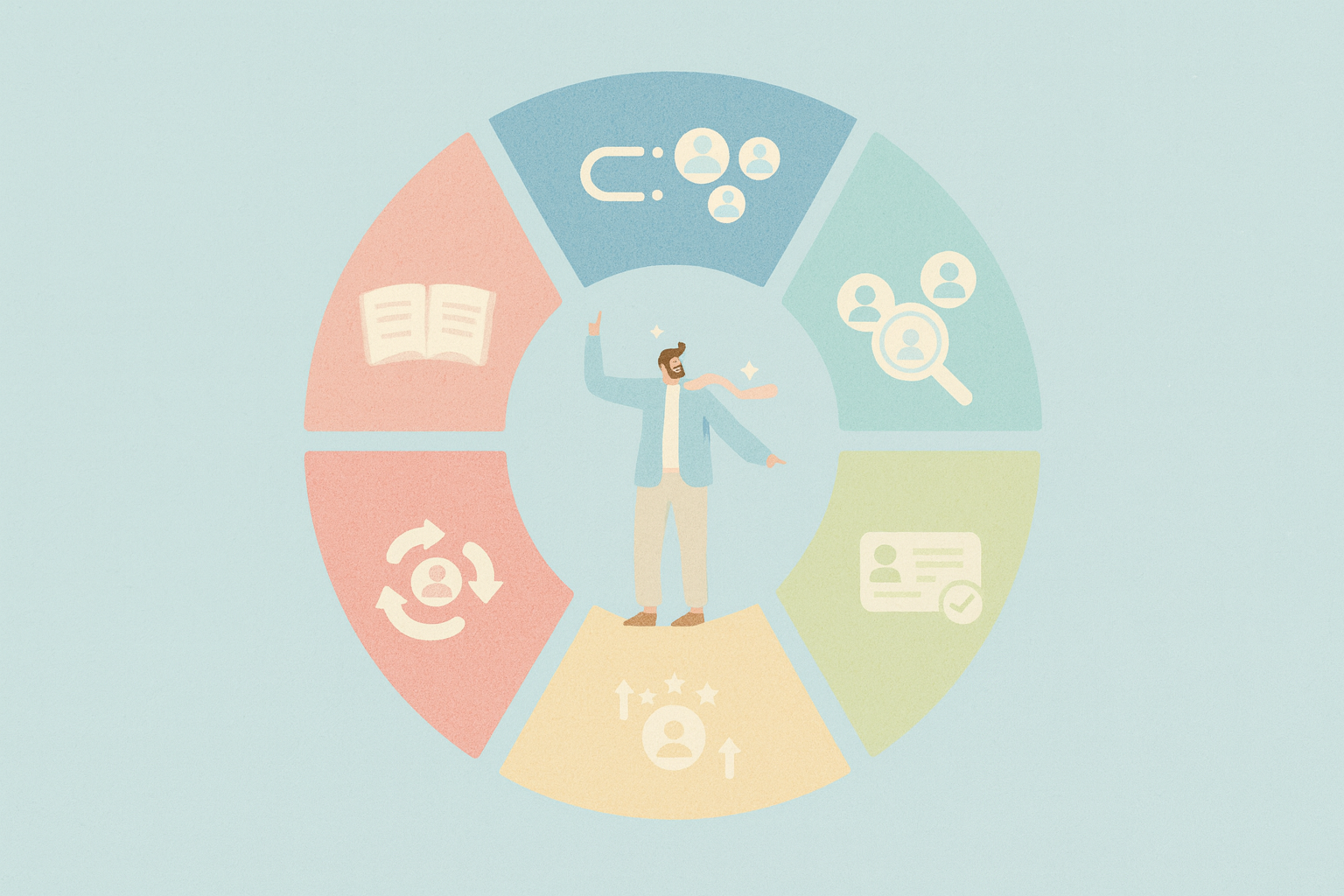
THE 6 STAGES OF THE EMPLOYEE LIFE CYCLE
The employee life cycle (ELC) is a framework that guides businesses in managing the full employee experience, from first contact to departure. It connects people strategy, engagement, and retention—key elements for any growth-focused company. This model also measures how each stage impacts organizational performance.
Hiring top talent is only the start. To build strong teams, companies need a strategy that supports employees from their initial interaction to their last day—and even beyond, when they may recommend the company to others. That’s why managing the full employee lifecycle is essential in modern HR strategies.
This guide explains each stage of the ELC and offers practical tips to improve them using HR best practices and technology. In many ways, the employee lifecycle mirrors the customer lifecycle.
WHAT IS THE EMPLOYEE LIFE CYCLE?
The employee life cycle is a strategic model dividing the employee journey into stages, starting before hire and continuing after departure. It helps organizations structure how they attract, onboard, develop, and retain talent.
WHY IT MATTERS
Companies using the ELC design proactive touchpoints to boost engagement, reduce turnover, and build a positive culture. Without it, HR processes can become siloed, with separate tools for hiring, scheduling, onboarding, and asset management—creating inefficiencies. By viewing the employee experience as continuous, companies can streamline processes with integrated HR software.
THE 6 KEY STAGES OF THE EMPLOYEE LIFE CYCLE
1. ATTRACTION
Before candidates apply, they form impressions of your company. Strong employer branding is crucial. Modern workers value competitive pay, purpose-driven missions, inclusivity, and alignment with personal values. According to Deloitte, 50% of Gen Z employees have declined tasks conflicting with their values, and 44% have turned down job offers for the same reason.
- Showcase culture and employee experience on your careers page and social media.
- Encourage employees to share authentic stories.
- Monitor reviews on platforms like Glassdoor and Indeed.
2. RECRUITMENT
This is the first formal interaction with your company. A smooth, respectful, and inclusive process is key.
- Streamline applications to reduce drop-offs.
- Use structured interviews to reduce bias.
- Communicate regularly—avoid ghosting candidates.
3. ONBOARDING
Onboarding should make new hires feel welcome, set expectations, and provide the tools to succeed.
- Create a role-specific 30-60-90 day plan.
- Pair new hires with mentors or buddies.
- Integrate culture and values into onboarding, not just logistics.
4. DEVELOPMENT
Career growth is a major retention driver. Deloitte found 21% of Gen Z and millennials choose employers based on advancement opportunities.
- Offer clear career paths and development plans.
- Encourage regular feedback and coaching.
- Invest in training, mentorship, and upskilling programs.
5. RETENTION
Retention reflects the success of earlier stages. Employees stay when they feel valued, challenged, and aligned with the company’s mission.
- Run regular engagement surveys and act on feedback.
- Recognize and reward contributions meaningfully.
- Support internal mobility and career progression.
6. SEPARATION
Turnover happens in every company. Offboarding should be structured to protect your brand and culture.
- Conduct exit interviews to identify trends.
- Understand personal reasons for leaving and make improvements.
- Maintain relationships with former employees—they can be brand advocates.
USING HR TECH TO SUPPORT THE LIFE CYCLE
Managing the ELC without technology is inefficient. All-in-one HR platforms centralize processes—posting jobs, onboarding, performance tracking, and offboarding—into a single system.
CENTRALIZING PROCESSES
- Faster hiring experience for candidates.
- Onboarding tasks completed before start dates.
- Unified dashboards for performance and engagement data.
- Visibility into all ELC stages from one platform.
AUTOMATION & REAL-TIME DATA
- Automated reminders, e-signatures, and check-ins.
- Analytics to spot trends and guide decisions.
- Scalable pricing for businesses of all sizes.
TRACK THE EMPLOYEE LIFE CYCLE WITH HR SOFTWARE
From hire to exit, the right tools keep employees engaged and processes efficient. With centralized systems, HR can focus on people, not paperwork.
Oriento is an all-in-one HR software built to manage the complete employee life cycle. It’s simple, affordable, and designed for modern teams. Register now for free.